
Not all workshop activities are “fun”. When a customer order comes in the “work” is not just starting – it has been underway for a while already. From “Raw” stock materials there is the cutting to length and shaping which gets done in preparation for “The final Turning”. We go through many feet of brass, steel, stainless steel, sterling, acrylic, delrin and a whole lot more in rod and tube form as well as “Flat sheet”, square stock and other shapes (also called “(cross) sections” in many thicknesses and widths.
We buy lumber by the “board-foot” and then cut it down into more manageable lengths and widths – most of which requires at least 2 years to “season” and cure by drying out. There is always dunnage or “loss / waste” incurred because the lumber not only shrinks, but also because every time we trim it down or drill it there is dust, shavings, chips and curls which fall to the floor. Some of this makes for very good kindling for the woodstove – as do our errors and experiments which did not quite go as planned. This is true for all of artisanal crafts.
When we say it can take upwards of 3 years to produce a set of bagpipes we mean it – we cure (dry) our wood for as long as possible to ensure even moisture content and dimensional stability. Sometimes that dried wood bends or twists as it dries and if we don’t leave enough “extra” then we may wind up with an expensive piece of timber we may have to sacrifice to the workshop heater. Even the boring of holes thru the “raw” wood stock is a necessary loss of timber – drill to big a hole and the bore may be too large, too small and the timber may not dry in the time we want it to. We wax the ends of the timber to prevent cracks caused by the shrinkage during the drying.
Some folks believe that the timber is “inexpensive” or “Cheap” – and that may seem so, however with a 30% waste rate on average that means that the cost of the final turned item has increased by 30% before we even add the cost of the making / turning into the equation.
Time = $$ and $$ = Time
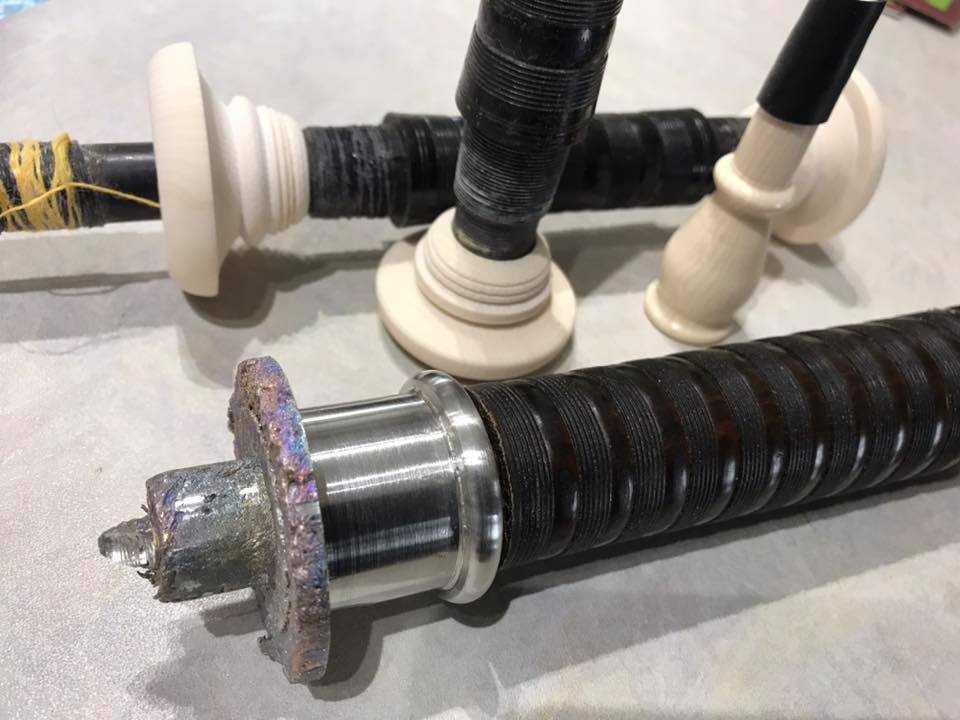
We do try to use “machines” to help increase production speed and capacity. But it’s not as simple as “feeding the raw stock into the hopper and turning the machine on”. No, before someone can even attempt to use a “machine tool” they must 1st know what they are doing “by-hand” as well as the damage and defects that the “making by hand” can incur on the work-piece – “the work”. Taking 1/64th of an inch too much off the work while using hand tools may mean that the work pace has to slow in order to not exceed the final tolerances. Make that same error with a machine-tool and you have magnified the error 100-fold or more. Having a piece of work come apart on a manual lathe or an engineer’s lathe is no laughing matter – sometimes all you see is an empty spot where the work was and then you hear the bang(s) as the bits find new homes about the workshop – hopefully not in the turner or anyone else present in the “‘Shop”.
The Works’ shop
Simply termed “The Shop” the place where all the frenzied activity of making goes on is more accurately called “The Works’ Shop”. Two separate words often strung together with a hyphen or flung out so fast that it is mistaken in singular form that rings on the eardrums of the un-enlightened as “workshop”.
The Works’ Shop traditionally had two “business locations”, a large facility where all the dirty-work (the making) was accomplished and another – usually much smaller – location where the “selling of the work” was done on “the High Street” – the street where all the people made their purchases, commissioned wares’ and interacted with the business owner and/or one of the businesses’ knowledgeable artisans who was moving up in the world from the “Shop-floor” to the “Retail / Sale Floor”. Where the works’-shop was in a basement level and the retail “shop-front” was at street level this literally meant “Moving Up in the world”.
